Mashroo3k Consultancy offers a comprehensive feasibility study for a private university project in Egypt, ensuring the highest profit returns and the best payback period. This is achieved through detailed studies of the education sector in Egypt, an analysis of competitors’ strategies, and offering competitive pricing proposals.

The private university helps provide opportunities for higher education to individuals from various nationalities, in fields such as medical sciences, engineering, and social sciences. It aims to prepare students in different disciplines for the labor market, offering the best internationally recognized educational curricula, modern teaching methods, and advanced educational tools. These elements work together to enrich students’ knowledge and enhance their practical skills, enabling them to meet the demands of the global labor market.<br>Mashroo3k Consultancy offers investors interested in investing in a private university in Egypt a range of specialized feasibility studies, based on up-to-date databases specific to the Egyptian market. This ensures the success of the project, achieving the highest profit returns and the best payback period.

Prime location and a highly efficient team.
Diverse services of the highest quality.
Best practices in dealing with trainees.
Outstanding academy management.
Presence of top-level chefs and technicians.
Executive summary
Study project services/products
Market Size Analysis
Risk Assessment
Technical study
Financial study
Organizational and administrative study
As Mashroo3k Economic Consultancy and Market Research Firm believes in the importance of the education sector and its role in national workforce localization, we are pleased to present the key indicators of the education sector in the GCC countries, encouraging investment in this vital sector:
The total number of students in early childhood education (including nurseries and kindergartens) in the GCC countries, according to the latest available statistics, is 851.5 thousand students.
The total number of students in school education stages in the GCC countries is estimated at approximately 9.3 million students (79.4% in the public sector, and 20.6% in the private sector).
The number of adult education students is estimated at around 181,247.
The number of higher education students is 2,206,446.
The number of early childhood education teachers is 50,647.
The number of school education teachers is estimated at approximately 727,904.
There are 5,806 institutions for early childhood education.
There are 32,310 institutions for school education.
Over the past years, the governments of the GCC countries have aimed to bridge the gap between education and the labor market by adopting educational curricula that prioritize vocational and technical education and encourage learning through modern technologies and media. It is also important to highlight that these six countries have increased their spending on education to ensure that generations are graduating to meet the private sector’s workforce needs.
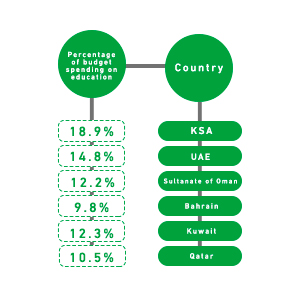
According to the latest statistics, Saudi Arabia spends 18.9% of its budget on education, the UAE allocates 14.8% of its budget to education, Oman spends 12.2%, Bahrain allocates 9.8%, Kuwait spends 12.3%, and Qatar allocates 10.5% of their budgets to education.
By 2023, the value of the private education market in the GCC countries is expected to reach $26.2 billion.
The global educational services market size was approximately $2882.52 billion USD by the end of 2021, and experts predict the market value will reach $3191.79 billion USD by the end of 2022, reflecting a compound annual growth rate (CAGR) of 10.7%. By 2026, the market value is expected to rise to $4623.90 billion USD, achieving a CAGR of 9.7% during the forecast period.